
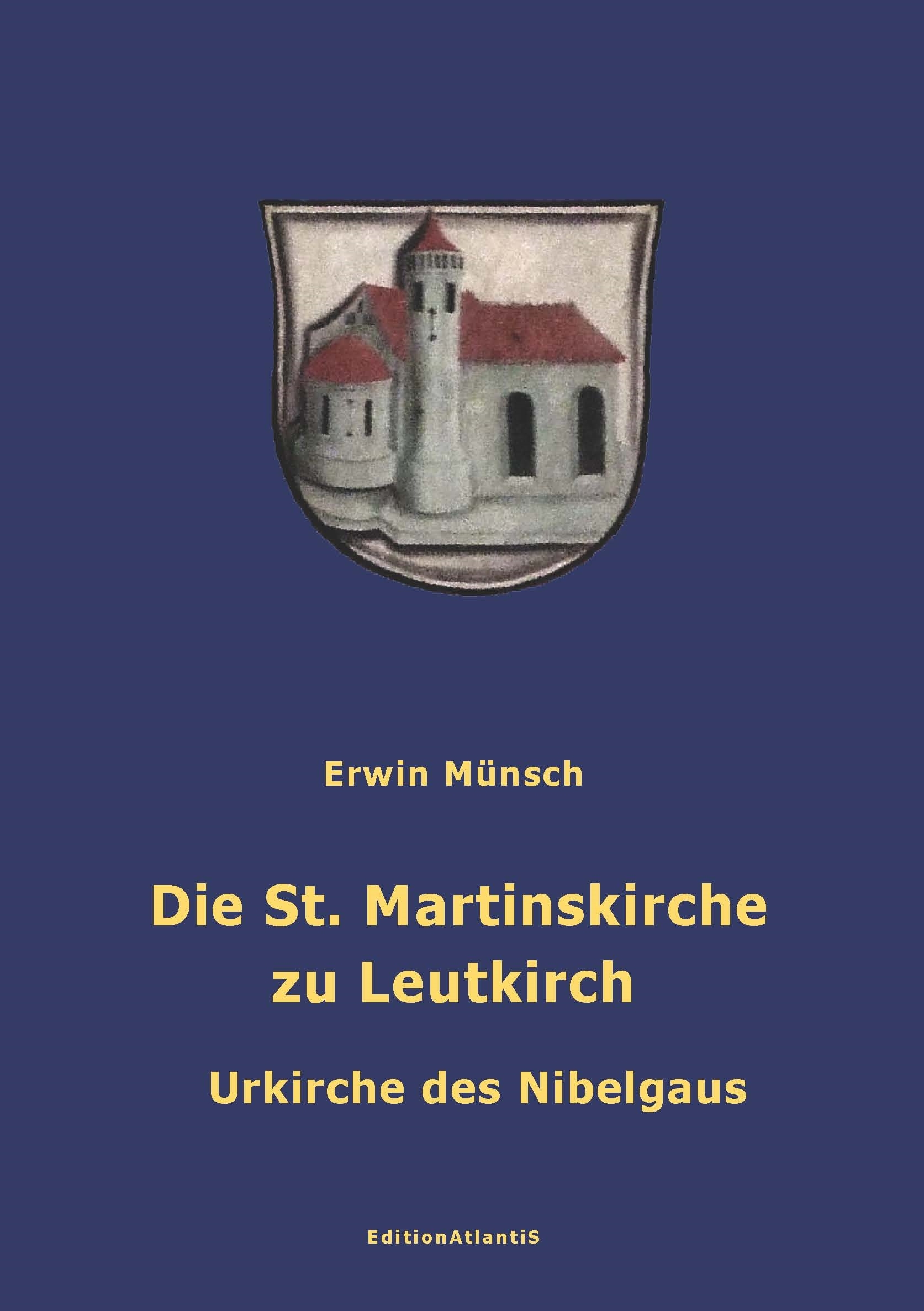
Die St. Martinskirche zu Leutkirch. Urkirche des Nibelgaus

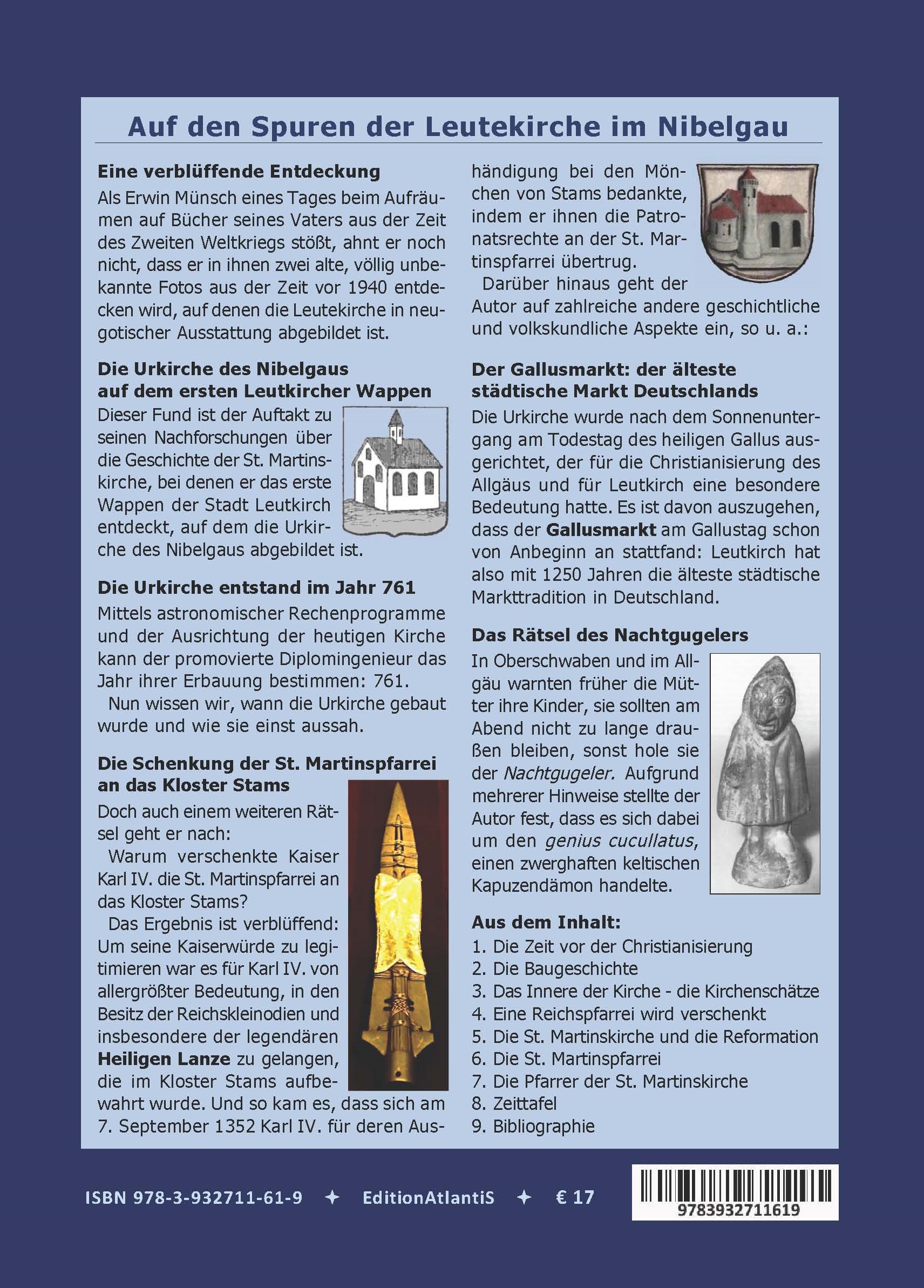
Tracing the Leutekirche in the Nibelgau
An astonishing discovery When Erwin Münsch finds two books from his father dating back to the time of World War II while cleaning, he does not yet suspect that he will make an astonishing discovery in them: old, completely unknown photos from the time before 1940, on which the Leutekirche is depicted with neo-Gothic furnishings.
The original church of the Nibelgau on the first Leutkirch coat of arms This find is the prelude to his research into the history of the St. Martinskirche, during which he discovers the first coat of arms of the city of Leutkirch, on which the original church of the Nibelgau is depicted.
The original church was built in 761 By means of astronomical calculation programs and the orientation of today's church, the graduate engineer with a doctorate can determine the year of its construction: 761. Now we know when the original church was built and what it once looked like.
The donation of the St. Martin parish to Stams Monastery But he also investigates another mystery: Why did Emperor Charles IV give away the St. Martin parish to Stams Monastery? The result is astonishing: In order to legitimize his imperial dignity, it was of the utmost importance for Charles IV to gain possession of the Imperial Regalia, and in particular the legendary Holy Lance, which was kept at Stams Monastery. And so it happened that on September 7, 1352, Charles IV thanked the monks of Stams for handing it over by transferring the patronage rights of the St. Martin parish to them.
Furthermore, the author addresses numerous other historical and folklore aspects, including:
The Gallus Market: the oldest urban market in Germany The original church was aligned with the sunset on the feast day of Saint Gall, who had special significance for the Christianization of the Allgäu and for Leutkirch. It can be assumed that the Gallus Market on Gallus Day took place from the very beginning: Leutkirch therefore has the oldest urban market tradition in Germany, spanning 1250 years.
The mystery of the Nachtgugeler In Upper Swabia and the Allgäu, mothers used to warn their children not to stay out too late in the evening, otherwise the Nachtgugeler would come and get them. Based on several clues, the author determined that this was the genius cucullatus, a dwarfish Celtic hooded demon.
Contents: 1. The time before Christianization 2. The architectural history 3. The interior of the church - the church treasures 4. An imperial parish is given away 5. The St. Martinskirche and the Reformation 6. The St. Martin parish 7. The pastors of the St. Martinskirche 8. Timeline 9. Bibliography
The (minimally changed) reprint is available/orderable from 03/10/2019. Pre-orders are possible via email (contact@editionatlantis.de).